

Transforming HR Leadership in Utah: Why Structure Drives Performance, Compliance, and Executive Buy-In
Across Salt Lake City, Sandy, Draper, and surrounding Utah markets, the role of Human Resources is evolving.
HR is no longer limited to hiring, onboarding, and internal policies. It now directly impacts compliance, payroll accuracy, workforce stability, and overall business performance.
But one challenge remains consistent across small to mid-sized businesses:
Getting leadership buy-in for HR initiatives.
Not because HR lacks value — but because it’s often not framed in a way that aligns with how executives make decisions.
Why HR Leadership Often Struggles to Gain Executive Buy-In
In practice, HR initiatives gain traction when they are tied to real business risk, not just internal improvement.
For many Utah businesses, that risk already exists inside daily operations.
Payroll compliance, for example, is one of the most common exposure points. The Internal Revenue Service (IRS) continues to report employer errors related to payroll tax filings and deposits, which can result in penalties and interest if not handled correctly.
Employee classification is another high-risk area. The U.S. Department of Labor (DOL) outlines strict criteria for distinguishing employees from independent contractors, and misclassification can lead to back wages and penalties.
These are not theoretical issues. They are operational realities for growing businesses.
When HR strategies are positioned as solutions to these risks, they become immediately more relevant to executive leadership.
The Shift Toward Structured HR and PEO Services in Utah
As businesses grow across Salt Lake City, Sandy, South Jordan, and Provo, HR complexity increases.
Responsibilities expand across:
- payroll services
- employee management
- compliance requirements
- benefits administration
Without structure, these functions often become disconnected or reactive.
This is why more businesses are exploring HR outsourcing in Utah and PEO services in Salt Lake City.
A Professional Employer Organization (PEO) provides structured systems for managing HR functions rather than building them internally from scratch.
According to the National Association of Professional Employer Organizations (NAPEO), businesses using PEOs:
- grow 7–9% faster
- experience 10–14% lower employee turnover
Structure, in this context, is not about outsourcing control. It’s about standardizing how HR operates.
What Actually Improves When HR Systems Are Structured
When HR and payroll systems are aligned, businesses typically see measurable improvements in:
- payroll accuracy and reporting consistency
- compliance tracking and documentation
- time spent on administrative HR tasks
- clarity in employee management processes
The Society for Human Resource Management (SHRM) notes that reducing administrative burden allows HR teams to focus on strategic initiatives such as workforce planning and employee development.
This shift — from reactive HR to structured systems — is what leadership is evaluating.
The Five Areas That Drive HR Performance in Utah Businesses
For companies across Utah, improving HR performance typically comes down to five core areas:
1. Work Analysis
Understanding where time is spent across HR and payroll functions
2. Organizational Structure
Clearly defining roles and responsibilities
3. Process Simplification
Reducing manual work and duplication
4. Targeted Automation
Applying tools only after workflows are clearly defined
5. Strategic Prioritization
Focusing effort on high-impact activities tied to business outcomes
These are not large-scale transformations. They are structural adjustments that improve how work gets done.
What This Looks Like in Real Utah Businesses
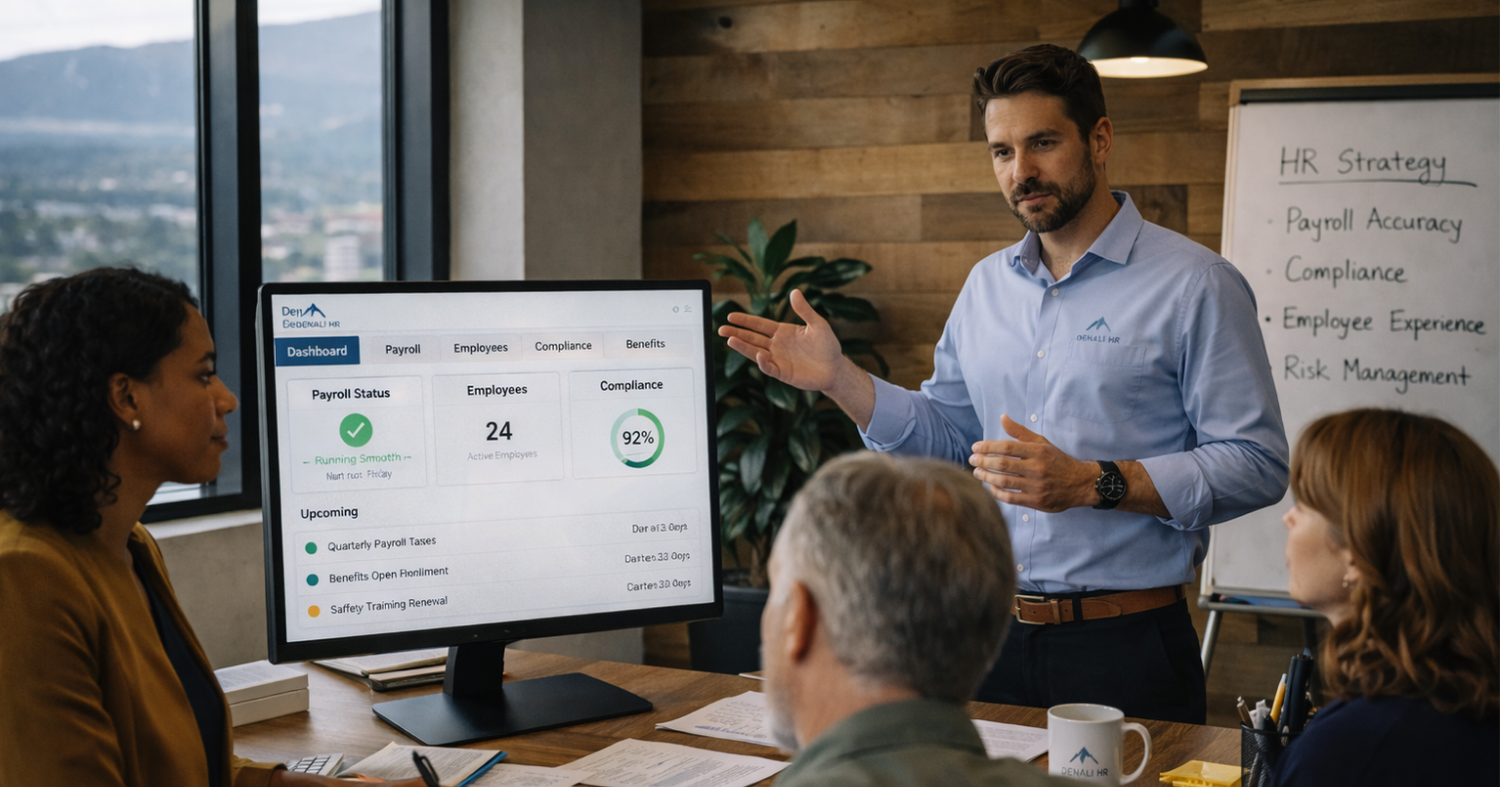
For businesses in Sandy, West Jordan, Draper, and Salt Lake City, structured HR systems create:
- more reliable payroll processing
- stronger compliance with federal and state regulations
- clearer employee management workflows
- scalable operations without increasing internal complexity
The U.S. Small Business Administration (SBA) highlights that managing employees involves ongoing responsibilities including payroll taxes, recordkeeping, and compliance — all of which become more complex as businesses grow.
Structure reduces that complexity.
Denali HR: Supporting Structured HR Systems Across Utah
Denali HR is a licensed PEO based in Sandy, Utah, supporting small to mid-sized businesses across:
- Salt Lake City
- Sandy
- Draper
- South Jordan
- Provo
Services include:
- HR services Utah
- payroll services Utah
- HR outsourcing Utah
- PEO services Salt Lake City
- compliance and risk management
Our approach focuses on building structured systems first — so payroll, compliance, and HR processes operate consistently as your business grows.
Ensuring Executive Buy-In & Compliance with Structured HR in Utah

HR transformation is often discussed in terms of tools, automation, and software.
But the real shift happens earlier. It happens in how HR is structured.
The businesses that see the most impact are not the ones using more tools.
They are the ones with clearer systems behind them.
About the Author
This article was reviewed by Josh Henderson, Founder of Denali HR. Denali HR, based in Salt Lake City, Utah, provides payroll services, employee benefits administration, HR support, and risk management solutions for small and mid-sized businesses. Founded in 2019, the company focuses on delivering personalized HR support without the complexity of large PEO providers.